01
All-IP architecture
Voice, control and management traffic over Ethernet; adding new users and devices becomes easier.
A shared IP infrastructure for crew, operators and communications devices.
ORION focuses on bringing in-vehicle intercom, operator stations and existing communications devices together on the same voice infrastructure. User roles, radio access and platform connections are arranged according to project requirements. Management and expansion of the system are thus handled through a single integration approach.
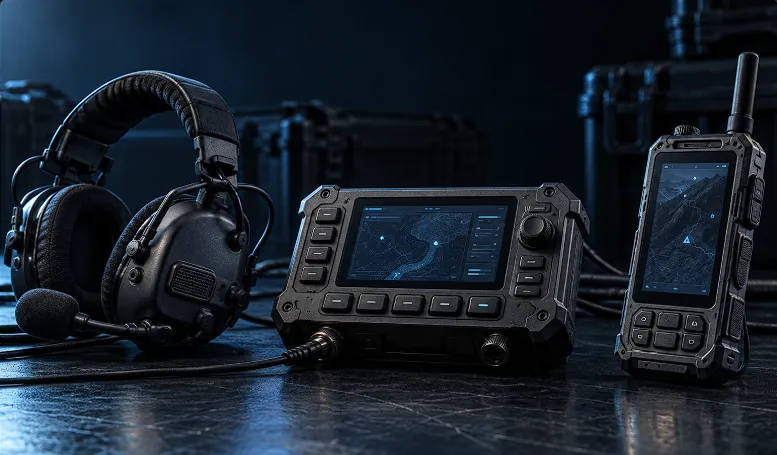
In a vehicle, several radios, crew stations and personnel outside must all communicate at the same time.
Legacy intercom systems require additional cabling and hardware for every new radio or user, increasing space, weight and power consumption in the vehicle. Personnel who dismount are also often cut off from the intercom.
ORION carries all voice over the IP network. Each crew station reaches the radios and talk groups within its authorization from a single panel; dismounted personnel stay on the network wirelessly.
Voice, control and management traffic over Ethernet; adding new users and devices becomes easier.
Listening and talking on several radios from each station; relay between radios (retransmission).
Digital noise suppression for intelligible voice in environments with high engine and track noise.
Channel and radio permissions are defined in software by role, such as commander, driver or gunner.
Dismounted personnel join the intercom and radio network wirelessly.
Management software for conversation recording, fault detection and system configuration.
ORION components are designed to work together; they can also be used separately as needed.
In-vehicle IP intercom
In-vehicle voice communications with crew stations, headsets and push-to-talk (PTT) units.
Wireless personnel communications
A wireless connection for personnel outside the vehicle or moving freely inside it, with access to the intercom and radios.
Radio and system integration
A gateway that connects radios of different brands and types, intercoms and operator consoles to the IP network.
Coordination within the crew and use of several radios from a single panel.
Central voice management in vehicles with many radios and operators.
Personnel leaving the vehicle stay connected to its intercom and radios.
Shipboard and ship-to-ship voice communications between the bridge, operations center and damage control teams.
Hardware selection, functions and integration scope are determined by the operating environment. Let’s evaluate the right configuration for your project together.
| Architecture | Gigabit Ethernet backbone, IP/SIP-based voice, modular star topology. |
|---|---|
| Open standards | Alignment with the NATO STANAG 4754 (NGVA) architecture is targeted. |
| Environmental conditions | Design using MIL-STD-810 (environmental), MIL-STD-461 (electromagnetic compatibility) and MIL-STD-1275 (28 V vehicle power) as references. |
| Protection class | IP65/IP67 target for crew units. |
| Radio integration | Interfaces with analog and digital radios, remote radio access via RoIP. |
| Management | Tool for role and channel configuration, recording, fault diagnosis and software updates. |